


By Thomas Weston
Introduction
Understanding the breeding ecology and the success of our breeding seabirds is critical to understanding how our populations of birds are doing on island. Manx Shearwaters are a success story for the island, having featured both on a Merrel Advert by Nadeem Perera at the start of the year, and then subsequently on ITV News when talking about how Seabird Numbers Soar on Lundy Island 20 years since the Rat Eradication. For Manx Shearwaters, monitoring of the species can be undertaken through different survey methods. This could include using visual observations whereby the use of counts and estimates are analysed (see our Jenny's Cove count article), through standardised surveys every few years (see our Large Gull survey article), or through productivity monitoring of a specific seabird species (see our 2026 seabird article). With 2027 being the survey year for Manx Shearwaters on the island, understanding the breeding ecology and movements during the breeding season, in years that are not whole-isalnd surveys, is fundemental to our understanding and monitoring of the species.
This year was no different as with help from Eleanor Harris, Emma Abel, Jessie Dermody, Tara McEvoy-Wilding, Simon Parker, Chloe Langmead, Kirsty Cox, and Greg Lee the monitoring of the Manx Shearwater artificial boxes could be completed. In addition to this, understanding the movements of breeding adults during chick feeding was achieved through help from additional researchers from OxNav including Tim Guillford was joined by Joe parker. Additionally, engagement has been important, with additional visitors and helpers such as the Young Birders 2026 coming to visit the boxes, as well as the people who help maintain the boxes Tony Taylor, Adam Hobbs, the LFS work party, and the Ranger team led by Roger White.
Methodology
Monitoring the boxes
In total, across the study colony there are 30 artificial Manx Shearwater boxes whereby access into the burrows of the birds can be achieved to monitor individuals. The first Manx Shearwater of the year was seen on the XXth March. As a result, monitoring of the Manx Shearwater artificial boxes started on the 21st March. Checking of the boxes continued every 4-5 days. At each visit, any signs of nesting were noted i.e feathers, smell or poo, an adult in the box, or an incubating bird on an egg. For those adults who were present, the metal BTO ring was read, and biometrics were taken. To reduce disturbance, wing and weight was taken before the bird was returned to the box with all 30 boxes checked each visit. For each box check, the activity of the boxes were recorded with the final box status either prospecting, unoccupied, failed, or fledged. Prospecting birds were those who had shown signs up to June, without laying an egg. In comparison, boxes showing no signs of us throughout the season were considered unoccupied. Where an egg was laid, the date the egg was recorded helped predict an expected hatch date. Hatch dates have a range of five days, so we used 49 days as the average hatch date. Based on the last date an egg was not seen, and the first date the egg was seen, an estimated hatching period was calculated. As a result, one of the boxes was expected to hatch between the 19th and the 25th June. On the earliest hatch date a check is made to determine if hatching was successful. If hatching had not occurred on the first date, a subsequent check on the latest expected hatch date was achieved, wth checks made once a week for those eggs that had not hatched within the hatch period. If the egg hatched on or around the expected hatch date, an estimation of the age of the chick at first chick observation was made. For example, chicks who were emerging from the egg would have a hatch date of the day later, day 1 chicks tended to be damp and in the vacinity of the egg, whereby day 2-4 chicks had an egg tooth but were away from the egg shell. Chicks that were found later than this would be considered a 5+ day old chick. Checks were made once a week to weigh the chick, and an expected fledge date was calculated 60 days after the known hatch date, or 60 days after the estimated hatch date. Chick weighing was achieved by use of a bird bag and a persola. The weights were used to determine peak mass, a measure of survival and fledging success. If the chick died before fledging, or the egg never hatched, a cause of death was determined, and the box outcome was considered as 'Failed'. However, if the chick successfully fledged, the box outcome was considered as 'Fledged'.
Understanding feeding behaviour
In addition to the box checks, OxNav were keen to deploy GPS/GSM tags for each successful pair of Manx Shearwaters monitored. Their aim was to understand the feeding ecology whilst Manx Shearwaters were in the chick raising period. To understand these movements, Tim Guilford from OxNav came over for a week in June. To begin, the team retrieved GLS tags fitted in 2025. These tags recorded the migration routes based on sun light levels (data being anaylsed) and were mounted to a ring on the leg. To continue their GLS work, the team redeployed GLS tags for collection in 2027 with this data currently being collected. In addition, to understand movements, the other parent not fitted with the GLS was fitted with a lightwight GSM/GPS tag attached to the bird using a small back mounted tag. These tags are light-weight and are used for understanding feeding behaviour during the chick rearing process. The tag, solar charged by the sun, had an expected lifespan of 8 weeks before the battery finished and the tag fell off. The data was sent via the mobile phone network so we could 'live stream' the movements of the birds whilst they were away from the island. Interestingly, we were able to see dive depth and how fast birds were flying too, however, due to the data still being analysed, and as a result, we can only share a small section of the work.
Results
Monitoring the boxes
The boxes were monitored by the team from the 21st March 2026 to the 19th September 2026. In total, signs of activity were seen in 15 out of the 30 artificial boxes. Based on our box status definitions, 2 pairs were considered prospecting, 2 failed at egg stage, and 11 chicks successfully fledged. As a result, productivity this year was calculated at 0.73 which is high for the study burrows. Our efforts this year monitoring the artificial boxes have shown that the laying date for our birds was around the start of May. The expected hatch dates were calculated and the average hatch date was around the 3rd week of June. Chick feeding was very productive, and peak mass of the chicks was roughly around the 25th August this year whereby some chicks weighed up to 600g at peak mass. Even though there was one late chick, the majority of chicks fledged by the 1st September, with the last chick fledging around the 10th September. The birds that failed had both bred successfully over the past 2-3yrs and so this may have been a year where energy levels were lower than normal and desertion at egg stage was potentially high.
Understanding feeding behaviour
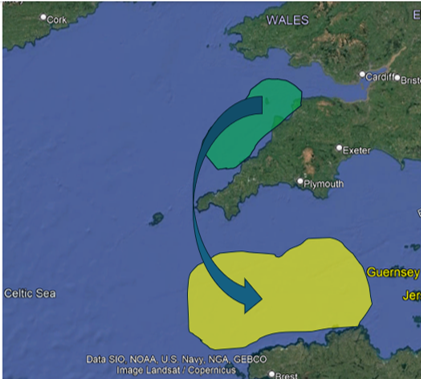 A rough view of our Manx Shearwater tracks. The area highlighted in green shows the local feeding for the chick, whereas the area highlighted in yellow shows the feeding areas used by the parents to self-sustain themselves. OxNav
In total, 10 Manx Shearwaters were GPS/GSM tagged by Tim Guillford and the OxNav research group with funding from Natural England. Without showing exact routes and feeding sites, this is a rough idea of where the birds are heading to feed whilst breeding on Lundy.
Discussion
The success of the chicks in the boxes this year was a surprise. The locally wintering seabirds that breed on Lundy saw a decrease in their survival overwinter, presumably due to the harsh winter weather just before they arrived back to breed. However, the Manx Shearwaters were certainly different, birds arrived back to the artificial boxes around their average date in good numbers. Last year, a couple more breeding pairs attempted to nest, though this year the breeding success of those who arrived back was higher. Overall, egg laying was a little later than normal, but syncronised, with the hatch date around the third week of June typical for the island. At locations such as Skokholm and Skomer, hatch date is slightly later i.e the first week of July, and the further North you go, the later the hatching occurs. This means birds in the Faroes Islands are much later than those on Lundy, and fledge later due to this this. Overall, hatching success was high with two eggs failing at this period. The adults had previously nested two or three years running so to take a year off for such a long lived species is not an issue. Last year was apparently a poor year for the Manx Shearwaters across the island. Looking at the productivity of the artificial boxes, productivity was higher than the estimate of 0.64 last year with this year's productivity being 0.73. This has led to an exceptional year for our artificial box birds, and it seems that it has been replicated over the island as a whole. By going out in the daytime and nighttime to Manx Shearwater colonies where they nest in natural burrows, breeding success seems to have been high across the island. Colonies to the east, south and west show that with every 11 alive chicks, 1 dead chick was found. This does not give an indication of how many eggs failed during the nesting period (which is higher than the number of chicks that fail), but it does seem a good measure of a successful year overall. We did not have enough time this summer to check the colonies in the north, but we can only assume breeding success was good here too. Taking into consideration there are roughly 15,000 pairs on the island, we expect roughly 10,000 Manx Shearwater chicks fledged this autumn if the 73% of all Manx Shearwaters successfully bred and fledged a chick.
The tagging data was super exciting. Tim Guilford from OxNav and the team were amazing and we really thank them for providing an extra layer of data to the Manx Shearwater boxes. Tim explained how in the previous 2011-2012 study, birds tagged did not go any further south than Cornwall, and fed mostly in the celtic and Irish sea. However, there has been a shift. Birds from the Welsh islands tend to feed in these waters nowadays and 'our' Lundy birds have shifted their behaviour slgihtly. Initial results of the tagging show that all of our birds undertake both chick feeding foraging trips, and self sustaining foraging trips. The chick feeding trips were more local feeding in the areas north of Cornwall and Devon, though a few trips were into the Celtic sea. These trips were a few days in length resulting in regular feeding of the chick. In comparison, the self sustaining foraging trips to replenish the adult's resources after spending days feeding the chick were further afield and mostly off the north coast of France. However, there were birds in the English Channel that were feeding too. By continuing the monitoring of the chicks during the period the tag was on the bird showed that chicks gained weight quickly. Chick wieghts were high, with the largest chicks reaching 600g at peak mass. This is phenomenal, and some very well fed chicks this year. This potentially was a reason why productivity was so high, good foraging and local food? In the marine heatwaves we had throughout the summer, was this really the case? Or was there new food arriving to excape the heat from further south? Something we are unsure about, but it was great to see such a high number of chicks fledge. Moreover, no chicks or adults failed due to the tags, or any obvious tag effects which was excellent.
Conclusion
A very successful year for the Manx Shearwater artificial boxes both in the monitoring and tracking. We aim to continue the box checks next year whilst undertaking the full island survey too. The retrieval of the GLS tags in 2027 will be able to provide an insite into migration routes used by our Lundy Manx Shearwaters.