


Bird Sightings
03/09/2026 – An Arrival
By Eleanor Harris
Today started off with a rather foggy and damp morning, a continuation of last nights eerie weather. As I did not have to start work till 12 noon, I joined Thomas for our daily census loop. It started off as foggy on the top but dropping into Milcombe this cleared. There had been an arrival with Robins filling the valley with birdsong. A good mix of species included Pied Flycatcher, Woodpigeon, Goldfinch, Goldcrest, Stonechat and adult and juvenile Blackbirds. It is amazing how yesterday the valley was a different story with everything sheltering from the persisting storm.
Carrying on the route it was amazing to see how localised fog and mist patches were, with the end of the island cloaked in mist and the south relatively free, with sea level clear and bright. Looking out to sea, we had a nice mix of Gannets, Manx Shearwater, Kittiwakes and Fulmar but it is noticeable how numbers of Manx Shearwaters are slowly decreasing with many starting their migration to South America.
Continuing on the route we hit the fog patch just after Rocket Pole with the number of birds increasing dramatically. It is interesting to see how weather changes affects bird numbers and what is visible. The mist continued from this point on with the air becoming slightly muggy, a change from the cool weather of the early morning.
Heading back to the village we both got ready for the day with some tea and toast had with the staff when we arrived back, Lundy tradition.
Meanwhile we heard a report of two Glossy Ibises from Greg yesterday, and that one of them had apparently decided to remain, as per one of our visitors. One of the Ibises flew down to the village and was spotted by our Ranger team heading into Barton Field. This caused much excitement and due to its accessible location many people got to see this bird including staff from their homes in Barton Cottages. What a treat it was to have this bird arrive, so in my break I went to take a look. We will see how long this bird will stay.
02/09/2026 – A Tavern Day
By Thomas Weston
Fog and strong winds cloaked the island with frequent rain too.
Greg was on census after a late night in the Tavern, but alas did not see much on his travels apart from a Green Sandpiper at Quarter Wall Pond. The day for me was spent in the Tavern. The poor weather outside was reflected by the number of people inside the Tavern. On my break, I took a leisurely walk down to Millcombe to help the Houskeeping team, hearing a Pied Flycatcher and a Goldcrest on the way down, plus more Robins. The weather cleared for a few seconds, the sun shone, but that was short lived and it went again. The rain descended and so I spent the rest of my break at the house, doing a little garden birding. Starlings and House Sparrows joined the Mallards, plus our odd-sounding Carrion Crow that was still calling like an alarm, or someone's phone! Back at the Tavern, I learnt that Greg had spotted a couple of Glossy Ibis flying passed Quarry Beach. These are only the 4th record for the island ever and it was nice to get this report on such a breezy, cloudy, foggy and at times damp day. Hopefully they are refound soon!
01/09/2026 – The First of the Month
By Thomas Weston
It’s the start of the month, and with autumn moving quickly in the bird world, it is amazing to see what has already passed through, and what may be around the corner. September is a time for more migration, and a few more scarcities, and maybe the odd rarity too.
September is a time the weather changes. All it takes is one low pressure to come through to make you realise that autumn is well and truly here! With windier and wetter weather than anytime since April, it is certainly doing just that here. September also sees a change in the island, the bracken starts to die back, and the leaves begin to change too. September is a time of more birders, bird ringers and more specialised guests. The summer holidays have come to an end now, and with only 7 weeks of boats left, this is the time to see Lundy fully wild and wonderful.
We think of the breeding season being over and for most that is true. Our resident species have well and truly done for the year, and the migration of our migratory species is in full swing, so they have also finished breeding too! A new Swallow brood found in one of the nests previously used this year with two eggs was a surprise. However, on inspection, it seems like the two eggs present have been abandoned, maybe as a result of the change in weather. However, the end of the breeding season for the Manx Shearwaters has not yet come! The majority of our adults, and fledglings have now left the island, but this morning I checked the artificial boxes with Jessie, and weighed the final four chicks. Being Jessie’s last day on the island as a volunteer, before returning to the mainland, it was great to be out and to see the chicks one last time.
The chicks were of very good size and weights. One was sleek and barely fluffy, another a little fluff around the vent, one with the stereotypical mohawk vibe with fluff on the side too, whereas the youngest of the box birds was relatively fluffy, though losing it quickly. The two oldest could easily fledge, though with the moon very bright last night, it could be a race against the clock this evening. I am sure they will be off and have all my fingers crossed for a little more cloud cover and then they will be able to head on off on their journey to South America. It will be amazing to see what we find next time in the boxes, though it seems like this may have been the last check with birds present!
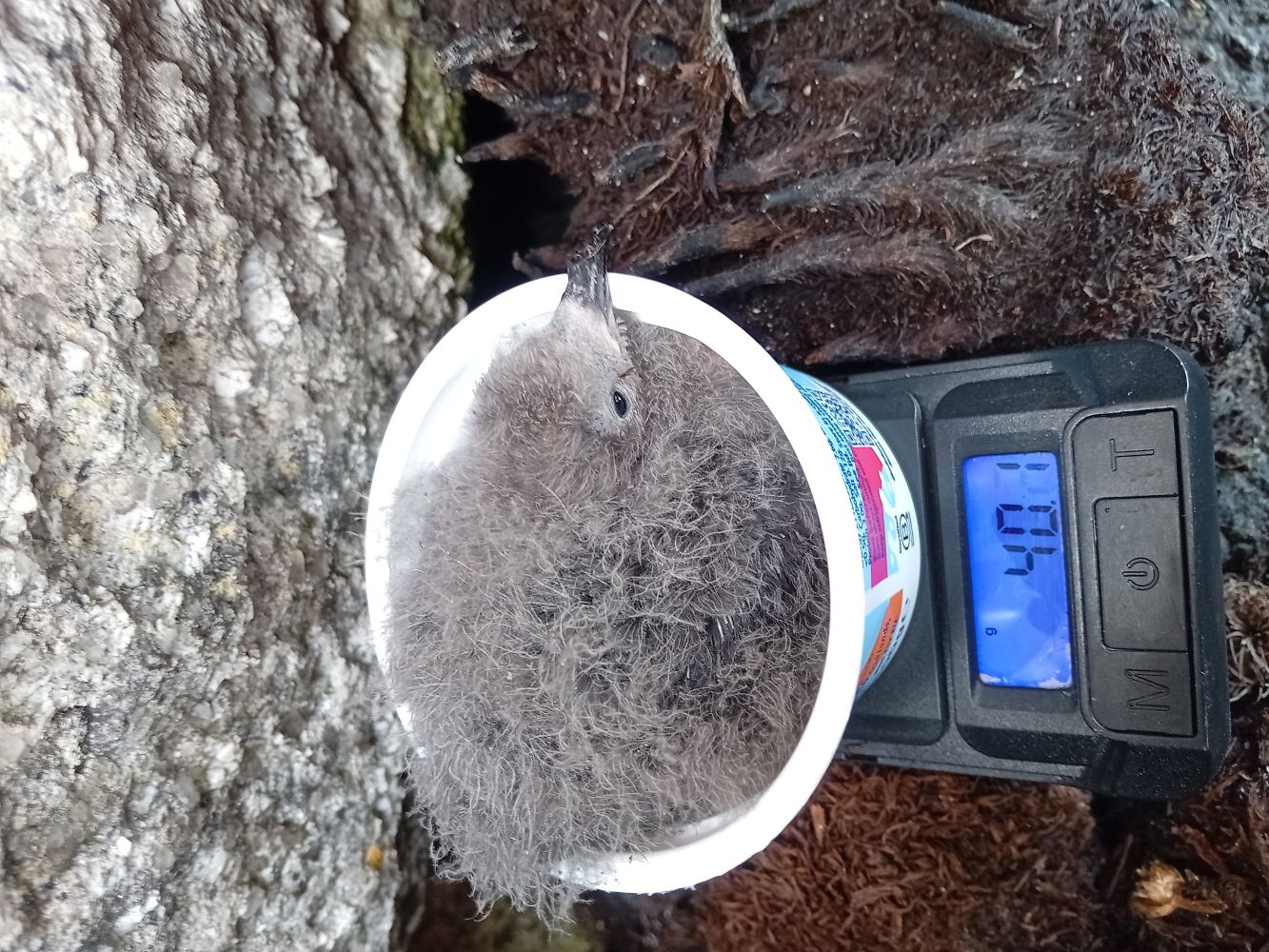 Storm Petrel chick at an undisclosed site by Thomas Weston
Our work with the seabirds is not over yet though. Another species still breeding is European Storm Petrel, which could go on into November! So, plenty more checks for me and the team to undertake in the meantime. Unfortunately, due to site sensitivities and the risk of disturbance, we have not been able to share our amazing work this year on this species just yet. However, a cute chick pic above gives an indication of how well they are doing, even after a later breeding season start.
After completing the Manx Shearwater box checks, I came on back and had a chilled morning ahead of my Tavern shift. It will be interesting to hear what Greg has seen on census. A Grey Wagtail spotted by him was the first of the autumn, but we shall find out more later….
31/08/2026 – Bank Holiday ducks
By Greg Lee
Today saw the start of some stronger winds from the west that are due to dominate the next week or so as we enter into September, my favourite month of the year. After what has been quite the ending to August with a nice mix of scarcities being discovered across the island, it was a quieter end to the month. My census this morning was marked by Robins being the commonest migrant across the island, the noisy ticking from the bushes being quite the feature in Millcombe, with some birds even breaking out into song, as territorial as they are. Two Pied Flycatchers, a single Spotted Flycatcher and a Whinchat at Rocket Pole where also notable sightings, with another three of the latter being located at other areas of the island throughout the day. A noisy Yellow Wagtail was over the Village, having had a few birds moving through over the past couple of weeks and often landing in Barton Field. A Sparrowhawk has been around the island for the past few days, though encounters are quite brief, today it zipped over lower Millcombe presumably looking for unwary and tired arrivals to take. Although I always take the time to gaze out to sea on census, I have been struggling to spot many seabirds as of late, with very few Gannets moving offshore and Manx Shearwaters also becoming thin on the ground. Still, fortune favours the brave and perhaps a skua or something else will pass through my binoculars one morning this autumn. Interestingly, a large influx of Painted Ladies seems to have occurred over the past couple of days, with many fresh-looking butterflies around the island.
Later on, with the bank holiday, it was time for the second duck race of the year, this time with a rather extravagant course, using water from Rocket Pole Pond, built by Ian, Rich, Roger and Emma. After a decent performance in spring, I was hoping that I might achieve a similar finish. That wasn’t the case though, with a final finish of seventh out of 13, though holding champion Emma saw a poor title defence coming ninth overall. A new champion was on the scene however, with Sarah and "librarian duck" taking the victory on its debut. A very impressive pedigree clearly.