


Bird Sightings
08/06/2026 – Introducing Sparrow Project PHD Student Lucile
By Lucile
Hello,
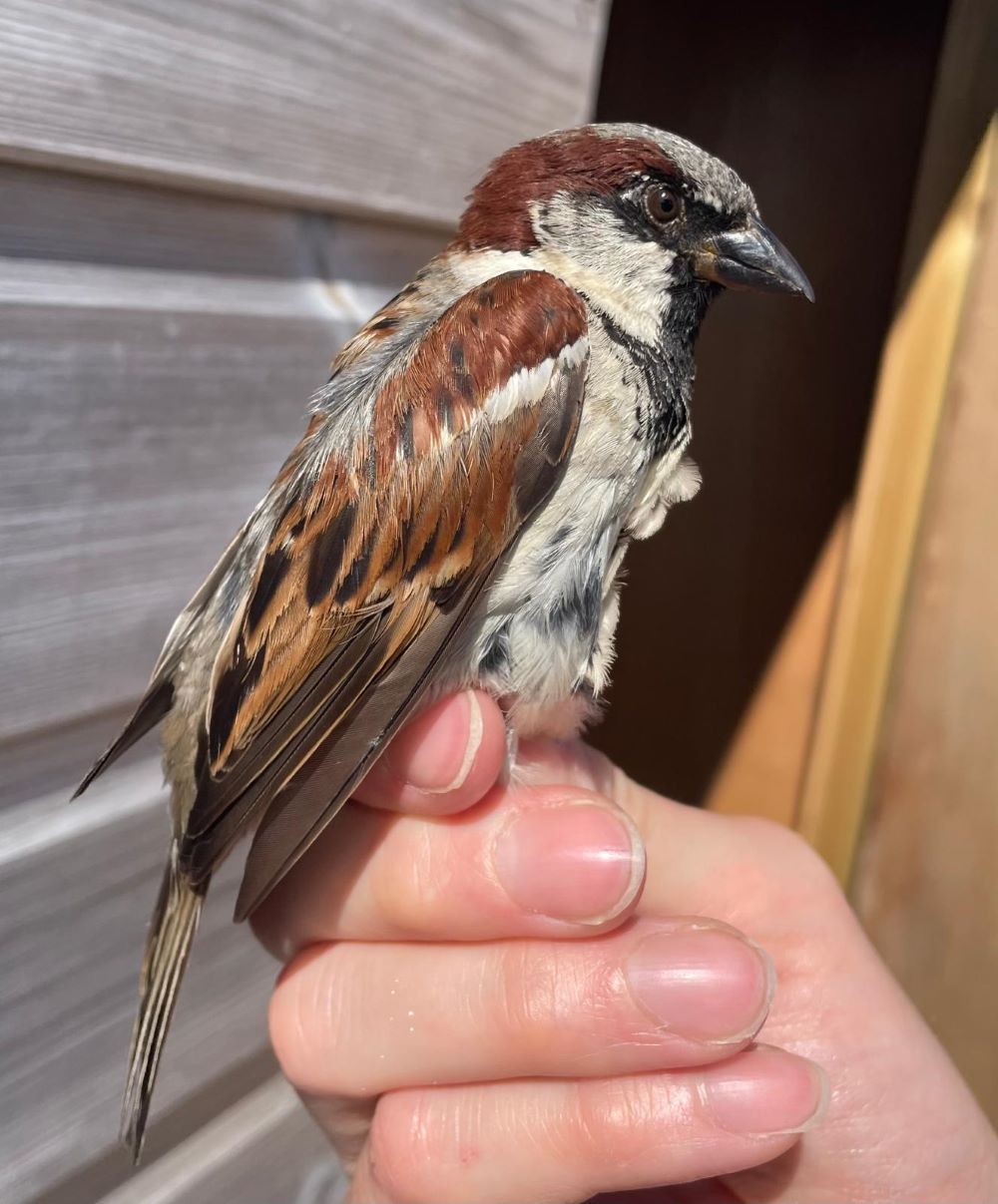 House Sparrow in the Village, ringed 9 years ago!!! Pic by Thomas Weston
I am Lucile, a new Phd student working on the Sparrow project. I come from France and do my studies between Taïwan and Lundy Island. I studied Neurosciences and Ethology in Toulouse (France), and finished my masters in Cornwall, studying the social environment of wild Jackdaws. I am extremely grateful to now study the influence of the social and ecological environments on the cutest individuals: the House sparrows (Passer domesticus) of Lundy Island !
House sparrows are socially monogamous species, meaning they form a pair bond with one unique partner during a breeding attempt. However, both males and females tend to reproduce with partners outside of the pair, which is called extra-pair mating. There are clear benefits for males to do so: with countless reproductive cells, they can increase the number of offspring with multiple mating. Females, however, invest in fewer reproductive cells, and they will lay a limited number of eggs. Mating with other partners therefore won’t increase the number of offspring they produce, and they will even suffer from reduced paternal care if their paired partner suspects cuckoldry. So, why are they doing it?
You might think that females cheat with males of higher genetic quality than their social partner, or with more compatible ones, to secure better genes for their offspring to inherit. These hypotheses, respectively called the good genes hypothesis and genetic compatibility hypothesis, have been widely studied across five decades of research. They surprisingly hold rather inconclusive results, with cheating females sometimes doing better, sometimes doing no better than faithful ones of the same species (sometimes even in the same population, as seen in blue tits).
Numerous factors might be in action to modulate extra-pair mating patterns, with the outcomes of cheating being actually context-dependent. For instance, mating with different males — thus increasing genetic diversity in the brood — might be adaptive in a fluctuating and unpredictable environment, allowing for at least part of the brood to survive. Genetic diversity might not make a difference under a favourable environment, in which anyone will have a high chance to survive.
The social environment could also make a difference! Group-living species tend to feed together with conspecifics (one example among other activities). Just like humans, they will associate more often with specific individuals, with whom they might eventually get more familiar. They will feed more often with specific “friends” than with others. It is possible that they associate preferentially with efficient individuals, with whom they find more food, for instance. In tit species and in corvids (and probably a lot of other species) information about a new source of food is easily spread between close associates. Therefore, there are many subtle reasons to benefit from associating with efficient foragers. Such social bonds in birds have only recently been studied, but it has already been observed that individuals mate or extra-pair mate with their closest “friends” (seen in blue tits). Could it be because females can assess their quality and select more performant males as their close “friends” / future extra-pair partners ? Lots of questions are still to be resolved! Could females cheat because it would allow for a higher diversity of offspring surviving in different environmental conditions to come? Could cheating with closest friends hold benefits that are still unexplored? This is a very exciting adventure to contribute to solving this mystery.
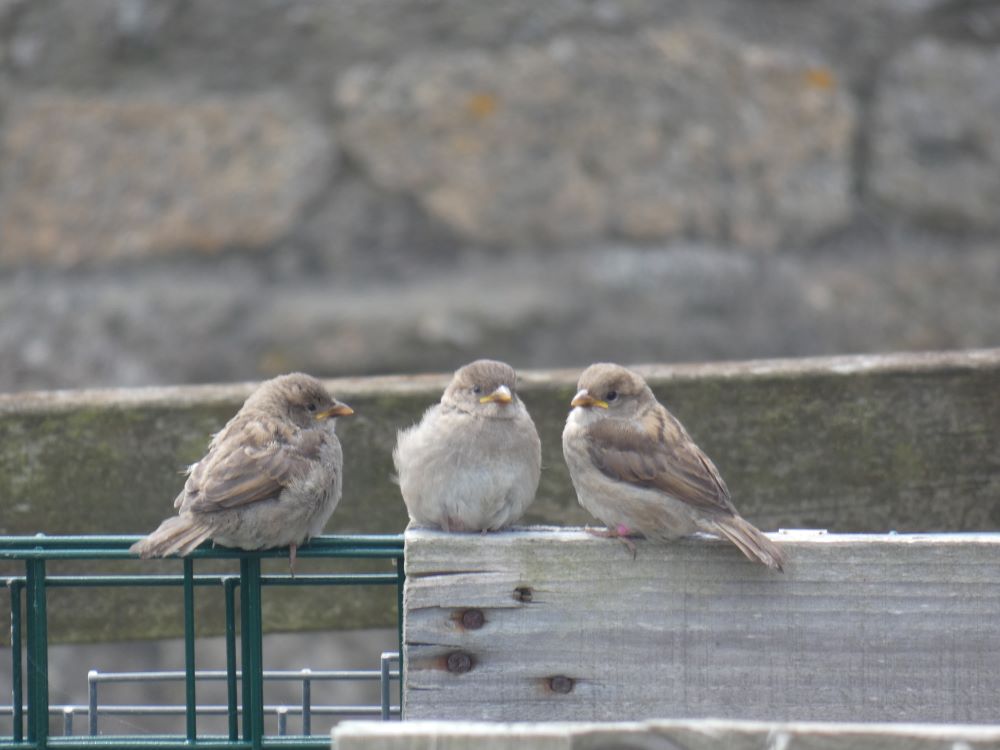 Fledged House Sparrow chicks in the Village by Thomas Weston
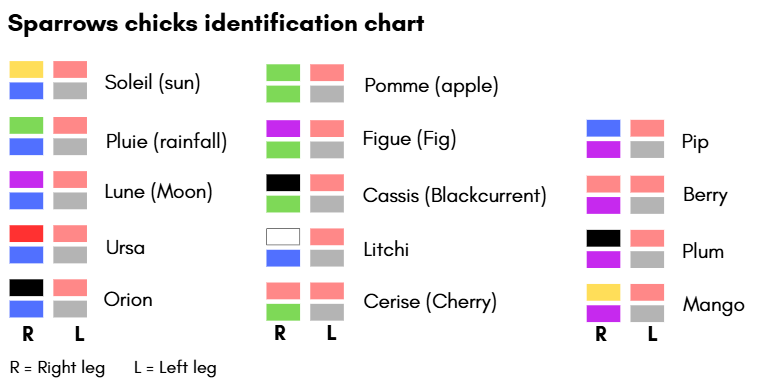 Our 2026 Colour ringed chicks created by Lucile
The Lundy Sparrow population is quite low at the moment. We have 4 broods so far, two of them having fledged already. If you see a juvenile, you can look for the rings: the left leg has a pink and a metal ring. On the right leg, the bottom ring indicates from which brood they come from:at the moment, it would be green, blue, or violet. Green brood chicks are named after weather elements, blue brood chicks are named after fruits, and violet brood chicks have been named by bird volunteers. The 4th brood will hatch soon! Hopefully they will do well and help the population thrive again. One little trap: pink metal (left leg) and blue pink (right leg) is an adult female named Fleur, she is not a juvenile.
If you want to discuss anything about sparrows, feel free to reach out! It is always very nice and interesting to hear when you see them.
07/06/2026 – A Sunday Travel Day
By Eleanor Harris
Today started off with warm, sunny weather with a light wind which made it perfect for a pre work walk. You may be asking why this blog is called ‘A Sunday Travel Day’ it is because the last few days of weather have meant that the boat has been unable to come on the normal scheduled days so staff and visitors have all had to adapt to the changing weather.
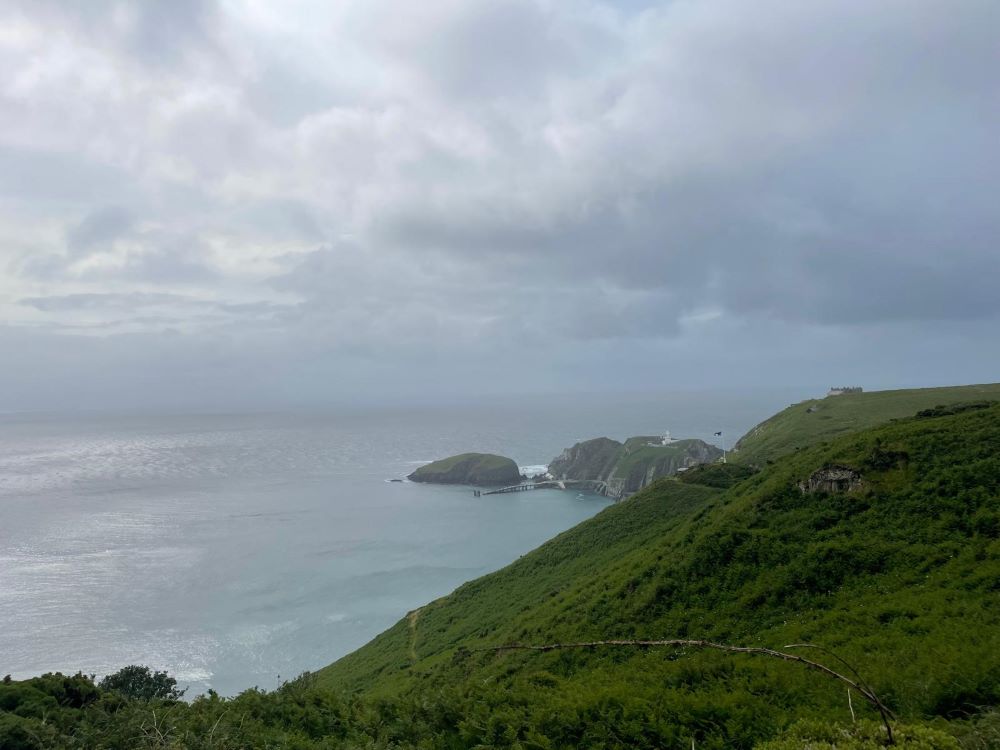 Landing Bay by Eleanor
Stepping out of the door it was noticeable that the temperature was dropping a few degrees, a change from the hot heatwave of a few weeks ago. Walking towards Millcombe the birds were out in force with lots of juveniles lurking in the bushes. The Upper East path was alive with birdsong making it rather peaceful with Swallows passing, Starlings and young hunkering in the bushes and Meadow Pipits surrounding the area. It was great to be out on such a beautiful morning and enjoy some much needed sunshine after a few days of rain, but this was much needed for the island which is starting to look increasingly dry.
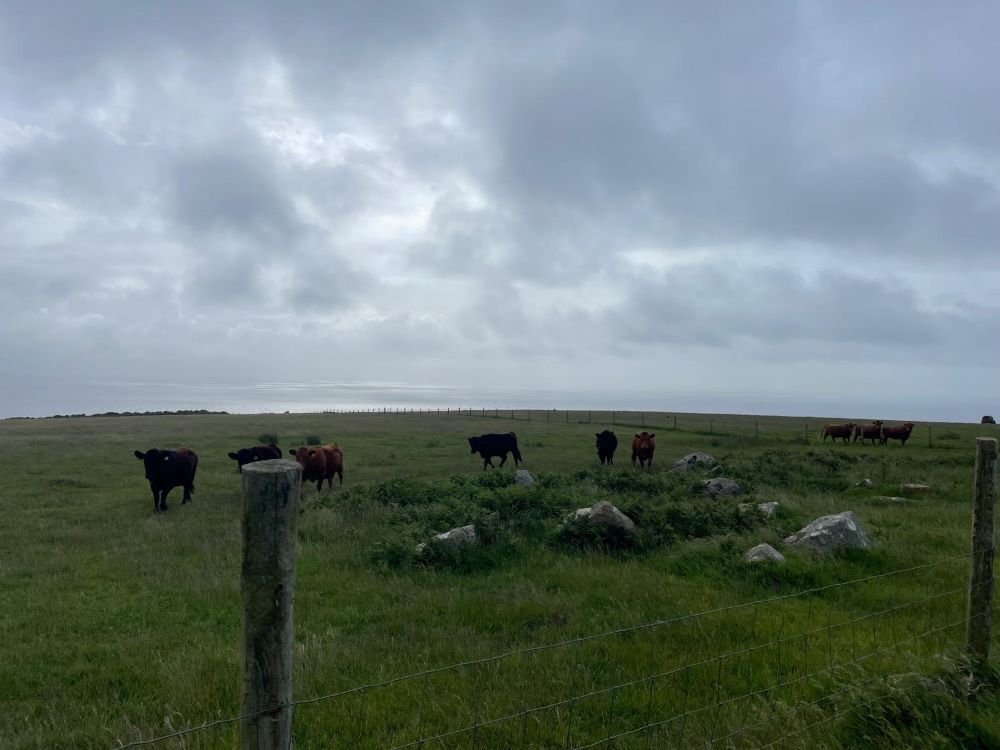 Dexter Cows by Eleanor
On my way back to the village I bumped into the Dexter cattle which were looking rather pleased with themselves! It was great to see the herd looking happy after a successful vet visit yesterday. I made it back to the village in time to have our usual ‘toast break’ with Thomas before heading out to complete a day of houskeeping. Before starting work I managed to complete a few tasks, getting rather distracted by the view before heading to work.
06/06/2026 – Jessie's blog: Marine mammals, Dragonflies and lots of birds!
Due to atrocious weather on 06/06/2026, with limited visibility and limited birds to boot, this blog entry covers 05/06/2026.
By Jessie Dermody,
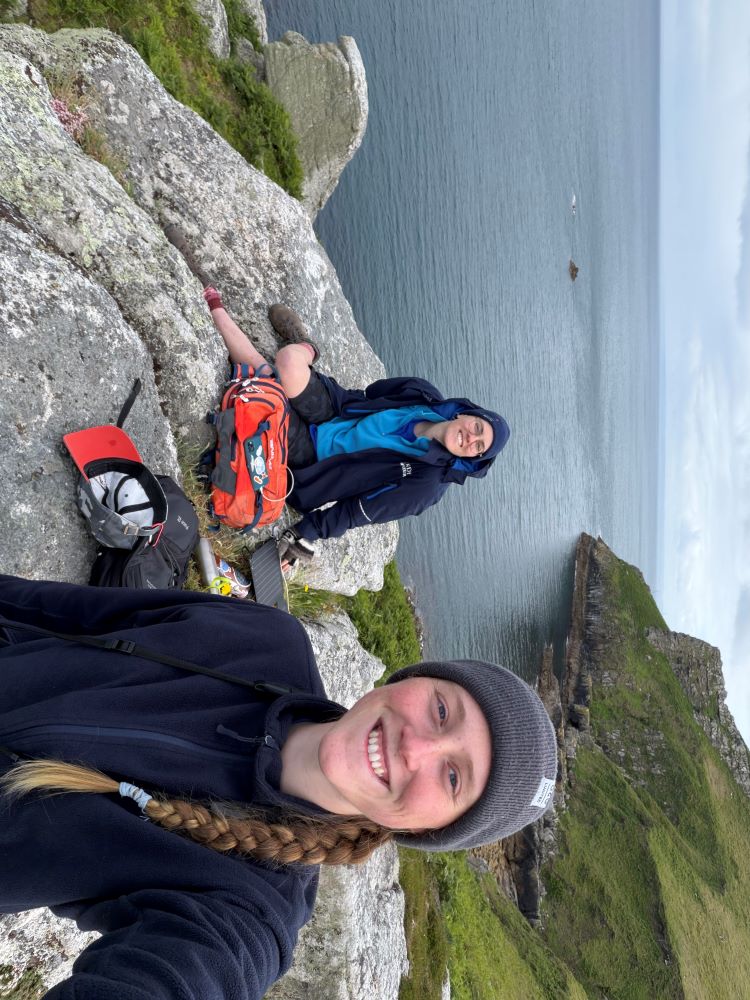 Selfie of Jessie and Chloë before our seal disturbance survey taken by Chloë
Hello sightings report readers! This is Jessie, the newest addition to the conservation volunteer team, coming to you live from the island with our sightings of the day! I am a research student and intertidal marine biologist, so on my days off you will find me in the sea or with my head in a rockpool. I came out to Lundy to expand my horizons, improve my bird identification knowledge and gain some experience. My first few days have been amazing, including watching the puffins, helping to ring some Manx Shearwaters at night and doing some exploratory rockpooling!
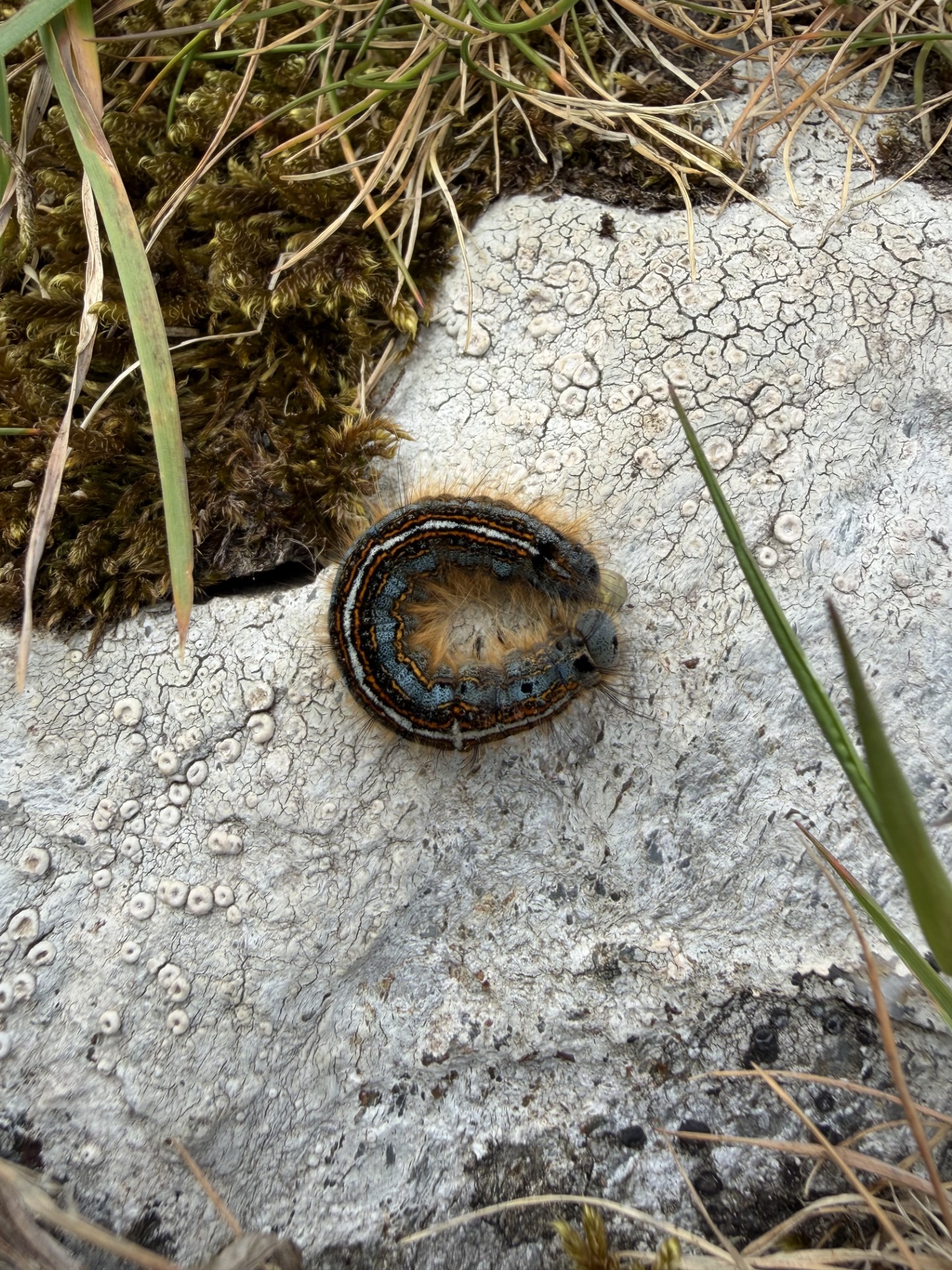 Lackey moth caterpillar photo by me
Today began with Greg and Chloë showing me the transect route for our regular butterfly surveys. It was a lovely and scenic walk, starting in Millcombe and working our way up around the east side of the island. Unfortunately, many of the butterflies did not show themselves, but we were able to record two moth species, several Small Heath butterflies, and 1 Common Blue. We also saw a beautiful Lackey moth caterpillar. The highlights of the route today were not butterflies, but an Emperor Dragonfly and a Blue-tailed Damselfly.
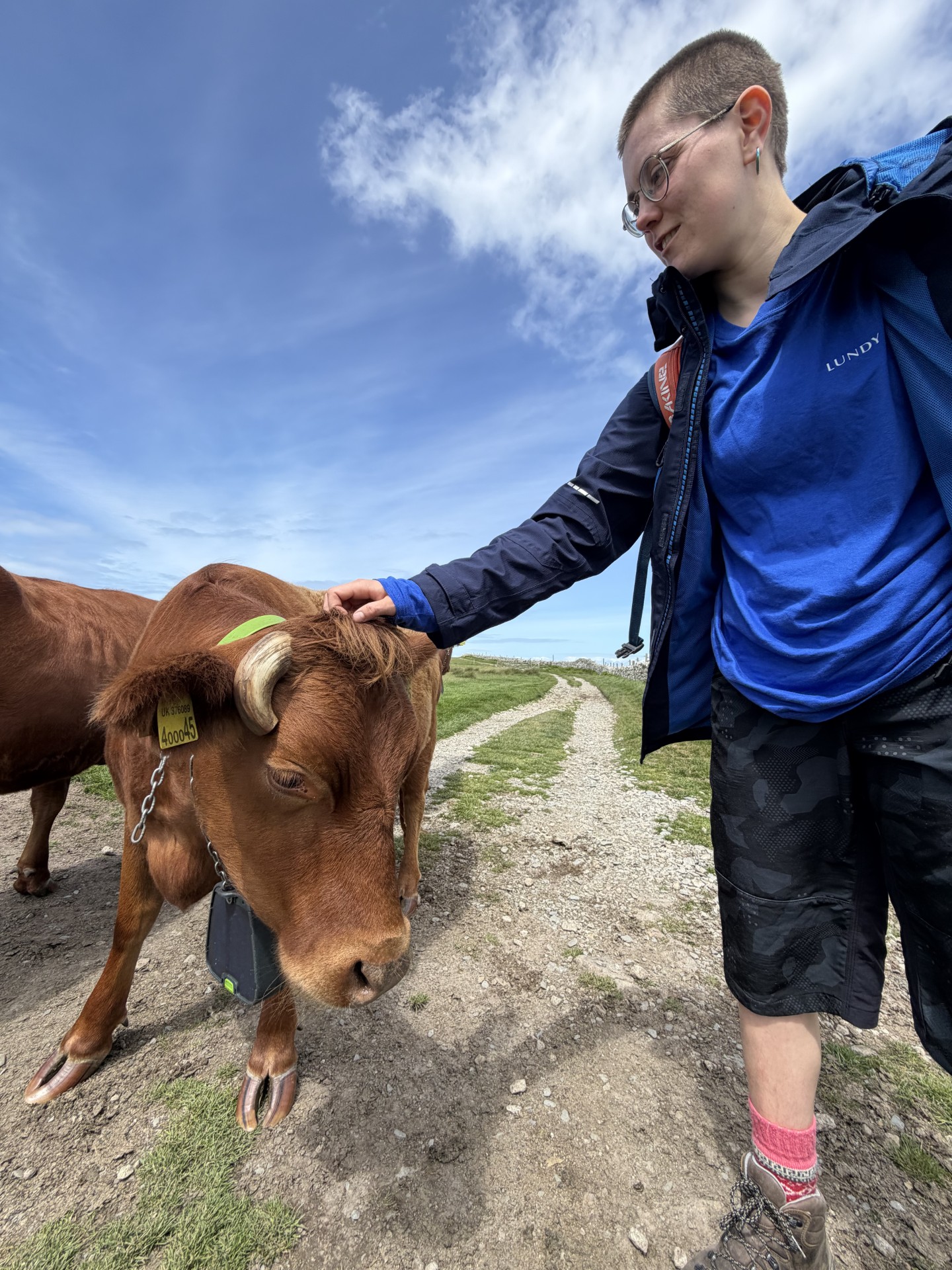 Cow photo by Chloë
After a quick lunch at the Lodge, Chloë and I headed off to the north east side of the island for our seal disturbance survey. Along the way to our survey site we ran into some of the new cows on the island, who seemed very friendly, as well as the Feral goats. Chloë also pointed out a beautiful Stonechat on our way back.
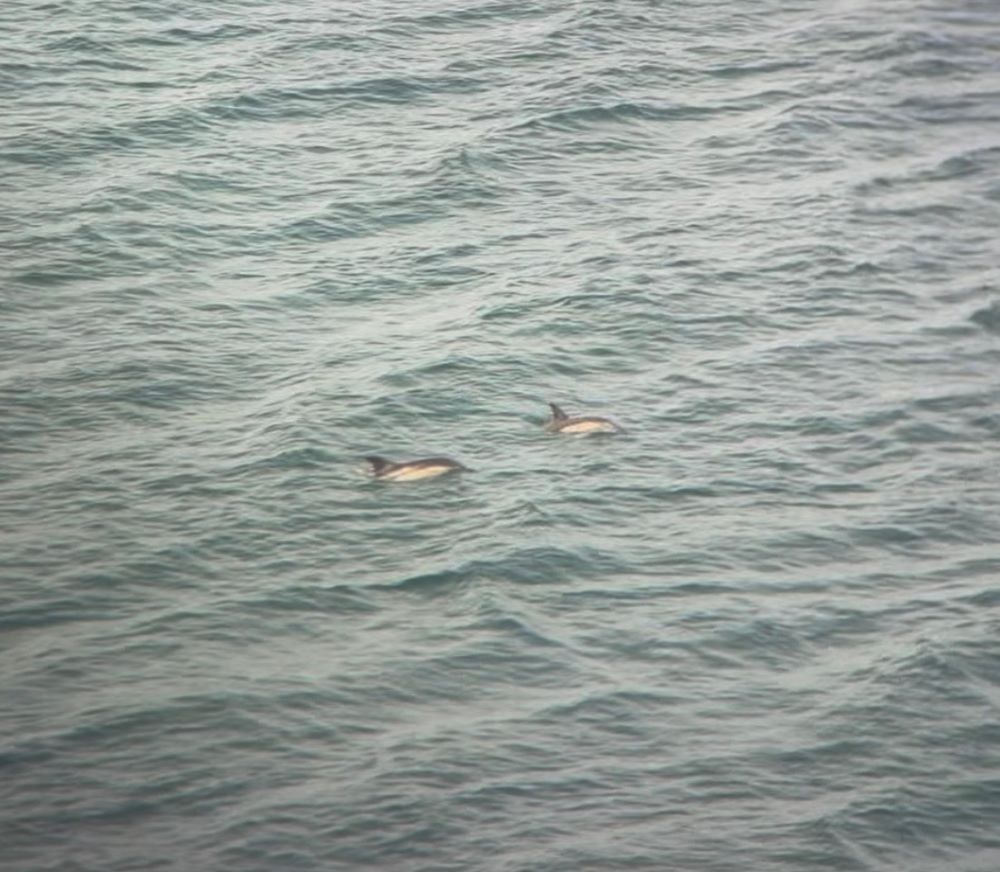 Dolphin photo through binoculars by Chloe
During our survey we did witness some disturbance, but we also saw plenty of happy Grey Seals! Our maximum count was 33 at one time, 5 seals in the water and 28 seals resting on the rocks. Eagle-eyed Chloë also spotted a male Kestrel above the cliffs, and counted 22 Razorbills rafting in the water. Towards the end of our survey time we enjoyed a welcome distraction as I spotted two Common Dolphins hunting and playing in the bay! We were both very excited as these were our first dolphins whilst on the island.
In terms of news from the rest of the island, our keen eyed visitors spotted a pair of Golden Orioles in Millcombe, as well as a Whimbrel! In our regular census, Greg reported a lone Siskin and our first juvenile Wheatear (on census at least). We have some exciting news to report from our Manx Shearwater colony; a new egg and a new pair of ringed birds at one of our productive sites! Hopefully this new pair will return to breed next year. We also recorded good numbers of auks around the island today.
Thank you for reading, I hope you enjoyed my first sightings report!
05/06/2026 – Heat, Habitat, and High Exposure - a guest blog by Jayden
By Jayden Parker
Hi all,
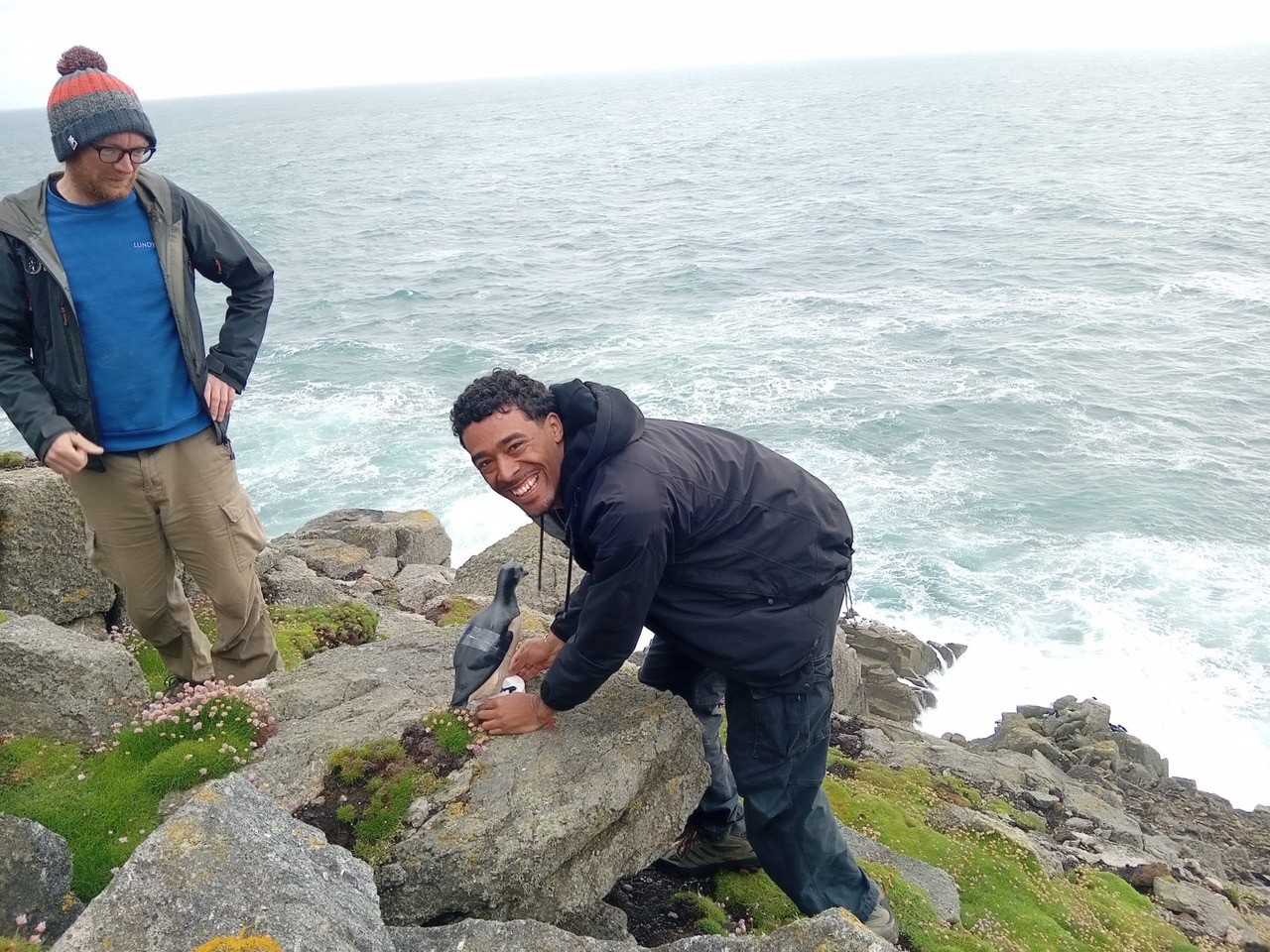 Me Setting up my first Guillemot model! By Thomas Weston
My name is Jayden Parker, and I’m a master’s student from the Royal Veterinary College, lucky enough to be doing a research project on Lundy! From the day I started this degree, the question of my thesis was always lurking in the back of my mind. Would I be able to find a supervisor with shared interests? Would we ever come up with an interesting question? Would fieldwork even be a possibility? Thankfully, the answer to all three questions - in my opinion - was yes.
Growing up in Bermuda, I began my conservation journey with the Bermuda Aquarium, Museum and Zoo at 14 years old. There, I had the pleasure of working with plenty of seabirds - namely the iconic White-tailed Tropicbirds and rarely the endangered Bermuda Petrel. I have also been lucky enough to do rehabilitation and conservation work in Borneo and the Galápagos Islands over the years! Given my interest in similar species, I thought I would seek out a project in a similar vein. My supervisor was quick to recommend Lundy Island. Due to his love for climbing, he had visited Lundy once before to traverse the most inhospitable cliffs the island had to offer. As such, he knew the island was home to an incredible array of seabirds - and thus began my path here!
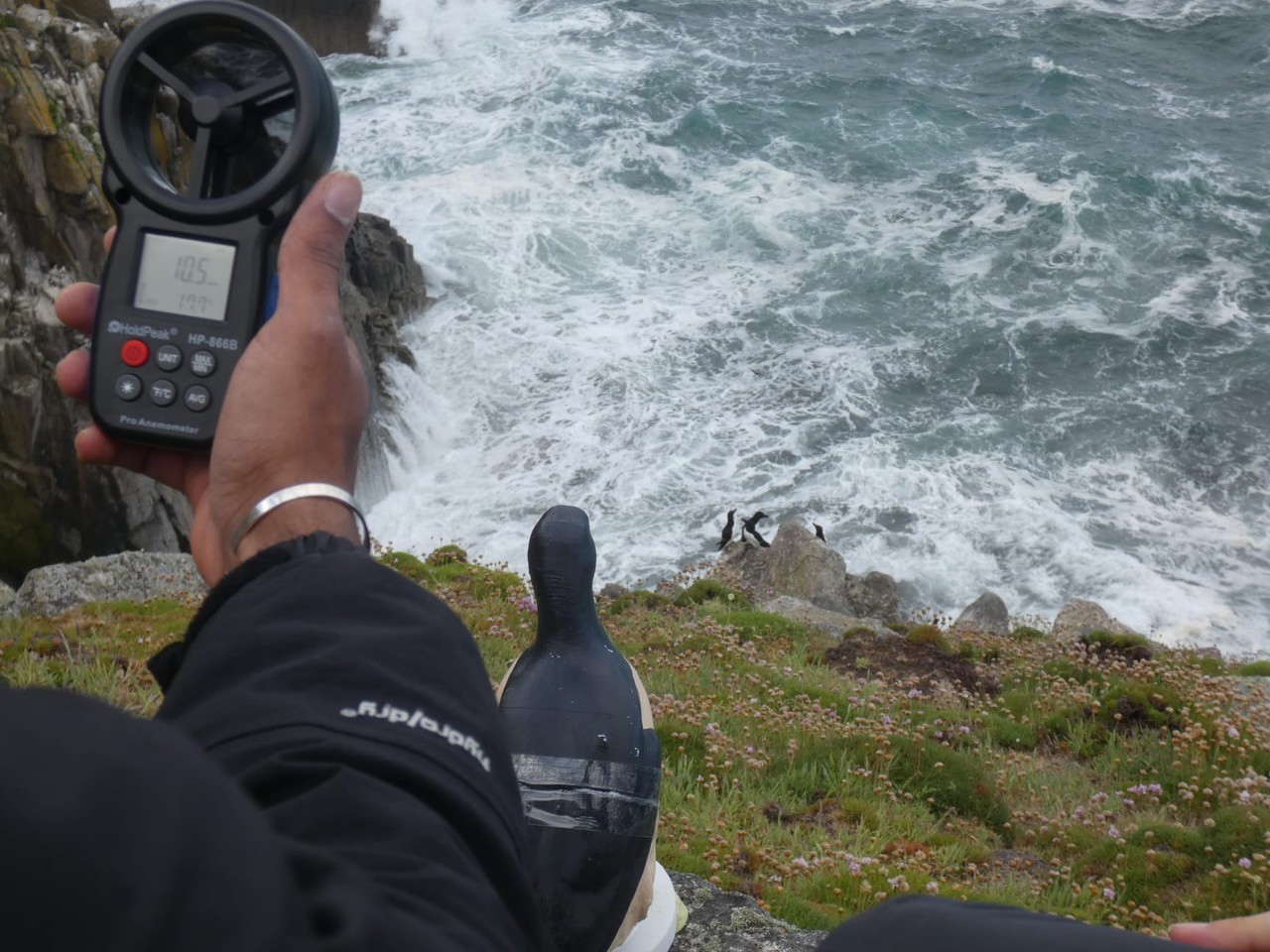 At each site, alongside temperature, testing the wind speed is essential! Pic by Thomas
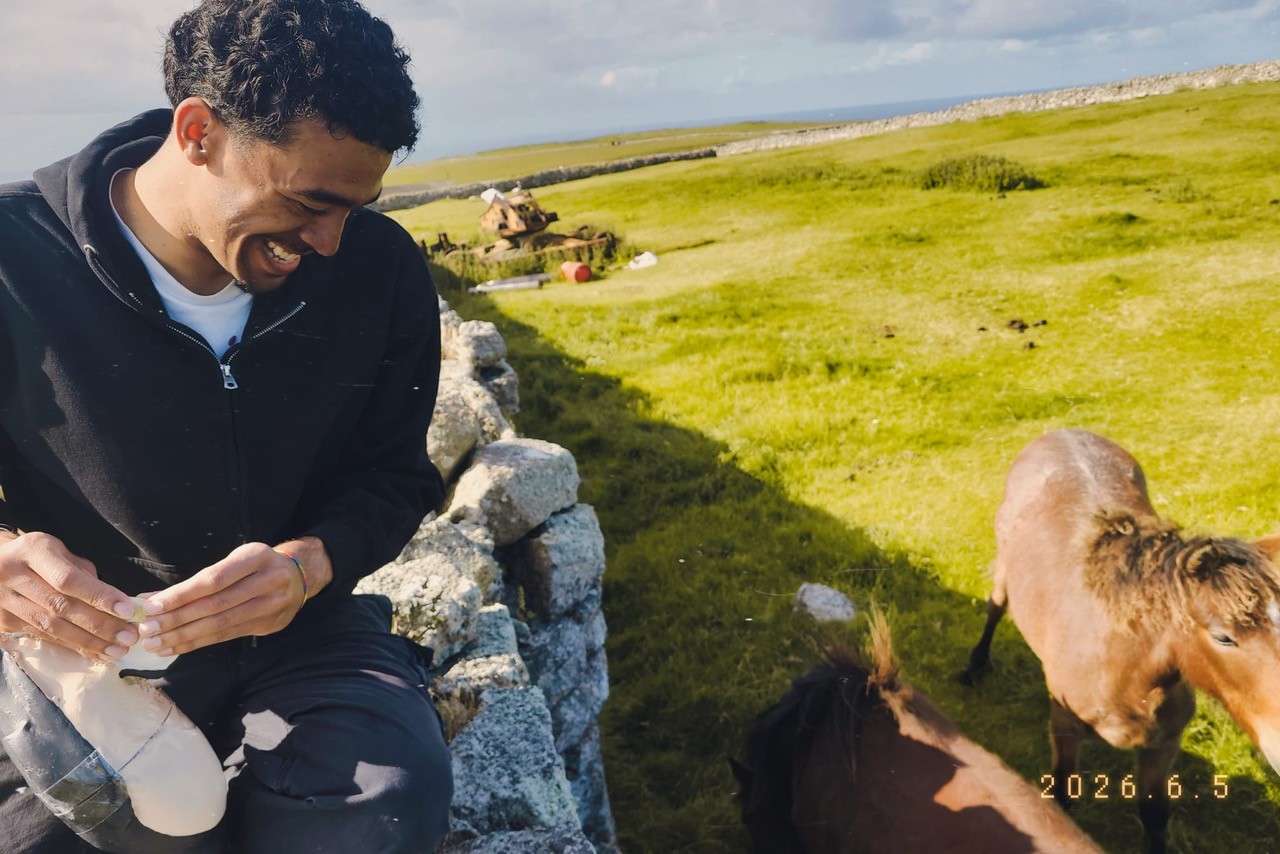 With a 'control' Guillemot set up everyday too!
Currently, I am working to investigate how Lundy’s seabirds are affected by the heat. Typical ambient air temperature measurements rarely tell the full picture. On granite cliff ledges, fully exposed to the hot sun, temperatures can significantly diverge from what the air temperature would suggest. This more representative temperature on the ground is known as the true ‘operative temperature’ experienced by these cliff-nesting seabirds. I am curious to find out how much these operative temperatures vary from standard air temperature measurements, and if slightly different cliff microhabitats play a role in the heat levels!
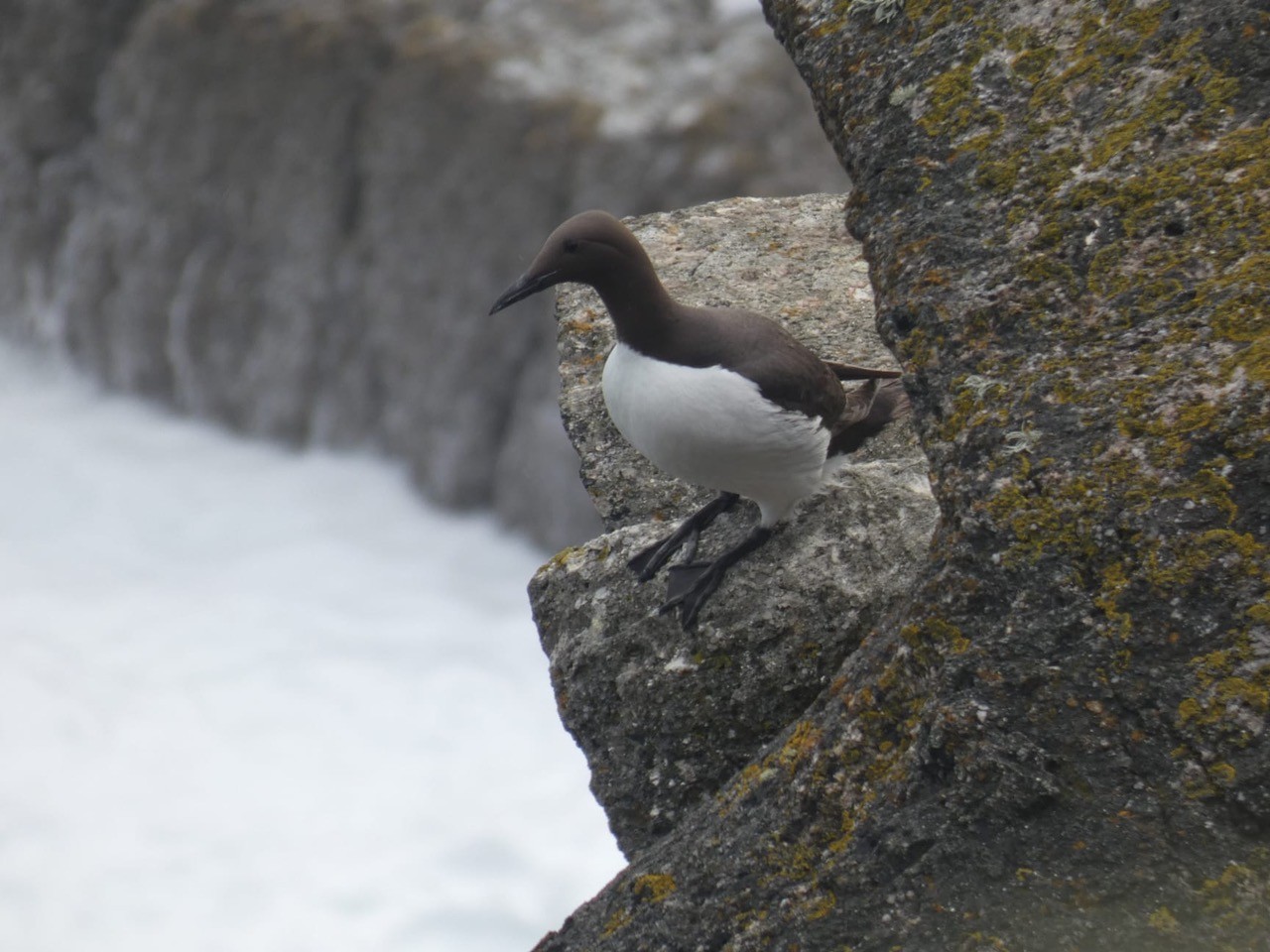 A Common Guillemot by Thomas
To do so, I have come to the island with four 3D-printed guillemot models. They are made from very specific materials and coated with very specific paint, all of which have been found to closely recreate the heat absorption levels of a Common Guillemot! Inside, I have a very hardy thermometer, and as of today, I have placed my first models along Lundy’s granite cliffs (see the pics above!). I plan to rotate them between different sites daily to get a better idea of exactly what temperatures these incredible seabirds are exposed to. As the climate continues to warm, research into the effects of heat on avian welfare and breeding success grows increasingly valuable. My work may also help validate the use of 3D-printed models for ecological thermal studies, and potentially to predict which areas might be most vulnerable to heat on warmer days.
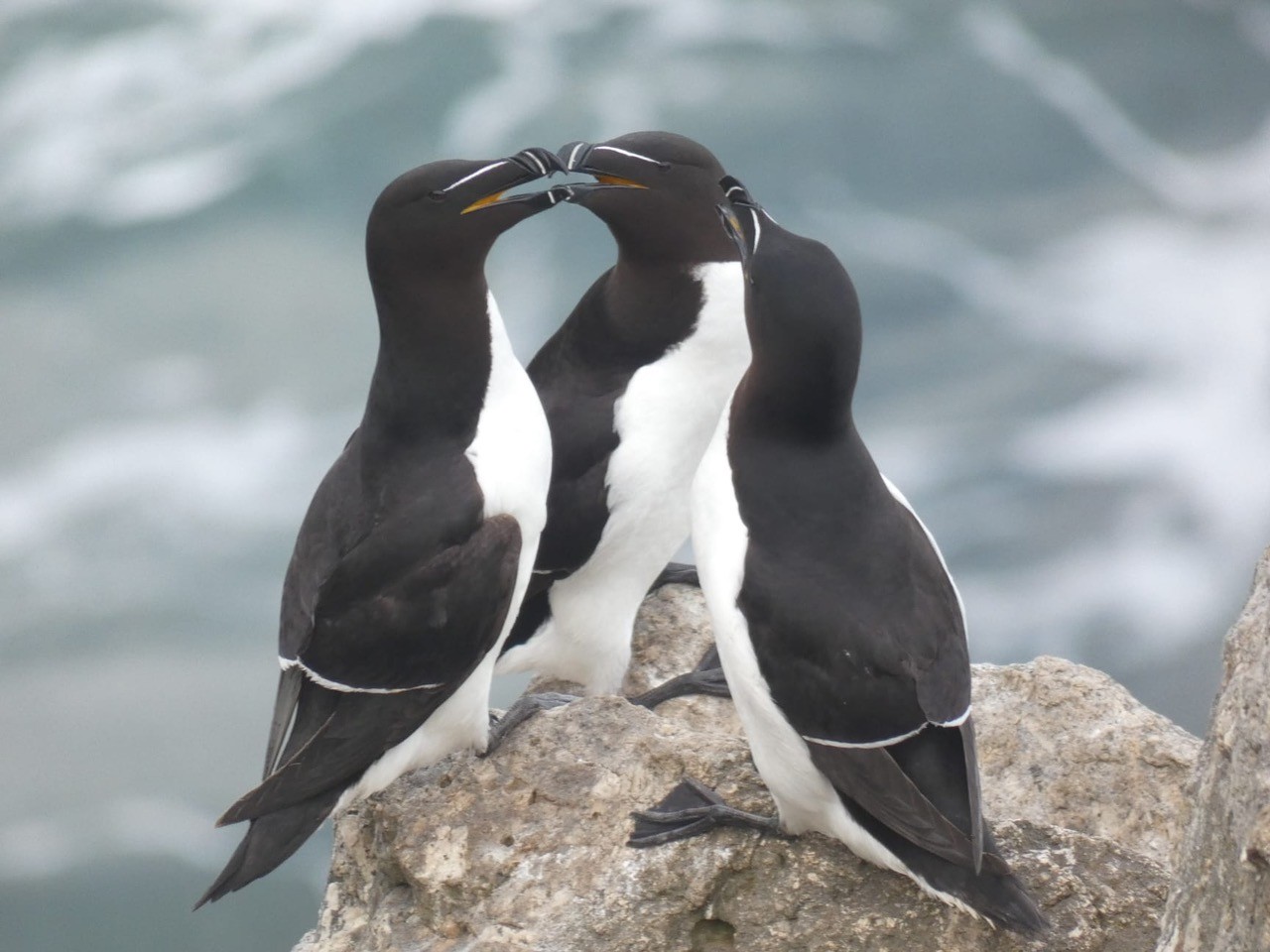 Some of the nosy neighbours who are also affected by temperature - the Razorbill. Pic by Thomas Weston
Outside of my research, I have been able to immerse myself in plenty of the activities that Lundy has to offer! I have spent a good amount of time trekking around the island, observing its incredible array of songbirds and seabirds (including Guillemots, Razorbills, Fulmars, Gannets, Shags, and, of course, Puffins), alongside the Sika deer, Soay sheep, and the ever wonderful Highland cows. It is quite like something out of a fairy tale! I even went for a swim in water far colder than I have ever dared touch before (in Bermuda, we rarely swim unless the water temperature is above 26 degrees).
Additionally, I have also been able to tag along with the volunteers during their duties. Some standout moments include helping with morphometrics on House Sparrows for the Sparrow Project, as well as catching Manx Shearwaters on the steep slopes after midnight for ringing! It was absolutely amazing, and unlike anything I’ve done before.
Overall, I have had nothing short of an incredible time here, and I am greatly looking forward to the next few weeks of my study!